“Awareness is not transformation. It is only the beginning of it.”
May 2025 | BY SHIVAANI TALESRA
A moment of honesty from the Coaching Room
I’ve been in the HR profession for over two decades. I hold ICF-PCC and EMCC-Senior Practitioner credentials. I’ve worked with hundreds of leaders — across industries, geographies, and career stages. And yet, the most important thing I can tell you about coaching is also the most uncomfortable:
Getting coached is not the same as being changed by coaching.
I’ve watched brilliant, self-aware leaders walk into a coaching engagement, do the hard introspective work, arrive at real insight – and then stop. Not because they didn’t want or coaching failed them. But because they ran out of runway just when the plane was ready to take off.
This blog is about that moment. And why what happens after the fifth or sixth or seventh session matters more than most leaders realise.
The Leaders Who Come to Coaching — And Who Don’t
Let me start with an honest observation from my practice.
Leaders who come to coaching sponsored by their organisations — where the company is paying and the engagement is assigned — often arrive with a different level of readiness than those who seek it out themselves. The latter have usually done their own research. They try to understand what the practice is about. They’ve decided they want it. The former, well-meaning and capable as they are, sometimes inquire and other times arrive asking a question they haven’t voiced yet: “Is this actually for me?”
That question is not a problem. It’s important. Because coaching readiness impacts coaching journey. But what I notice is this: when leaders don’t ask that question early and honestly, they shortchange the entire engagement. They participate without fully committing. They gain awareness, which is real and valuable — but they don’t may not stay long enough to make that awareness actionable.
And when the first series ends, the insight often evaporates back into the pressure of a full calendar and a demanding role.
The leaders who come to coaching with readiness, however? They almost always understand something fundamental: this is a journey, not a shortcut.
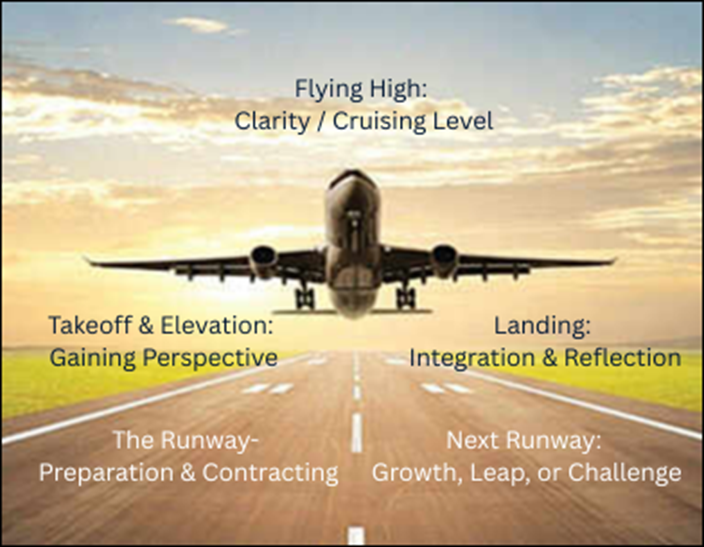
The Aircraft Analogy
Think of a coaching engagement as a long-haul flight. There’s the runway — the early sessions where you’re warming up, building trust, calibrating the work, figuring out what you’re actually here to address. For most leaders, this lasts through until three or four sessions. Necessary. Non-negotiable. But also, not yet the flight.
Then there’s the ascent — sessions four through six or seven, where the real patterns start to surface. Where you start to feel something shift. Where the questions start to cut deeper. Where you think: “Oh. That’s what’s actually been happening.”
And then — just when the plane is lifting off — most first-series engagements end.
Imagine if every flight had to ‘air turnback’ just a while after the take-off. You’d have all the preparation and none of the destination.
Coaching that stops at the point of awareness results to informed leaders who might revert to old behaviours. Because awareness alone doesn’t change the neural pathways that have been running your default responses for decades. It just makes you conscious of them while those pathways continue to run.
Neuroscience is unambiguous on this point. Research on habit formation shows that real behavioural change — the kind that becomes automatic, that holds under pressure – takes anywhere from 66 to 254 days, depending on the complexity of the pattern and the individual. The commonly cited “21 days to form a habit” was always a myth. The brain requires repeated reinforcement to shift old patterns into new ones. And for leadership behaviours which plays out in high-stakes, emotionally charged, complex situations — that timeline can differ from individual to individual.
Cognitive awareness is the first step. Consistent, supported practice over time is how it becomes who you are.
Where the Growth Breaks
In my years of practice, I’ve noticed a consistent pattern with those who experience coaching for the first time. Around the third or fourth session, something clicks. Leaders get into the groove of the work. They start to show up differently — more willing to be uncomfortable, more honest about what’s really going on, more curious than defensive. The sessions become genuinely productive.
And then, often around session six or seven, the first series wraps up. Sometimes because that’s what was contracted to begin with. Sometimes because the leader doesn’t pause to ask: “Should I continue?” Sometimes because no one in the organisation prompts the conversation.
What follows is predictable, and I say this with lot of compassion not criticism: they return to their environment — with new vocabulary and sharper awareness — and the environment wins.
The old triggers are still there. The habitual responses, the ones embedded in the basal ganglia, the part of the brain that runs automatic behaviour — those don’t care that you’ve had an insight. They fire anyway. And without the ongoing support or anchor to catch, reflect, and recalibrate, leaders find themselves, six months later, doing the same things in slightly more articulate ways.
They know what they’re doing. They just haven’t yet built the muscle to not do it.
This isn’t a character flaw. It’s neurobiology. And the real shift can happen if the coaching continues past the point of awareness and into the territory of sustained practice.
My Role As a Coach — And What I Make Clear From the Start
I want to be transparent about how I work, because I think it matters for leaders who are considering coaching for the first time.
I am rigorous in my intake process. Before we begin, I want to understand not just what you’re hoping to achieve, but what you’re willing to put into this. What does your availability actually look like? Who are the key stakeholders in your development? What conditions would make you likely to disengage? I ask because I’ve seen too many well-intentioned coaching engagements collapse under the weight of a leader’s packed schedule and an assumption that awareness alone would do the work.
The goal is that you don’t need me!
I mean that. Coaching is not about dependence. It is not about creating a relationship where you can’t make a decision without a session first. It is about liberation — building the inner architecture to make clear, grounded, confident choices on your own, with increasing skill over time.
What I hope for — and what I’ve been fortunate to witness — is something different from dependence. It’s a relationship that evolves with the leader, returning at the natural inflection points of growth, change, and transition. Not because they can’t move without coaching conversations. But because they know the value of a trusted, skilled thinking partner at the moments that matter most.
Three Leaders, Three Runways
Let me share what this actually looks like in practice — while keeping the confidentiality of my brilliant clients, but with enough detail that you might see yourself in one of these stories.
The Career Builder. A leader came to me while navigating complexity in a full-time corporate role: team dynamics, performance pressure, a difficult relationship with a senior stakeholder. We worked through it. She built clarity, held difficult conversations with more skill, and found her footing. The first series ended well in five months. A year later, she came back — this time preparing to step into her own independent practice and build a business. Different challenges, same rigorous work. Then again, when she navigated a significant transition in her personal life. And again, when she became a parent and needed to reimagine how she led herself.
The coaching was never the same twice. Because she wasn’t the same person twice.
The Global Leader. Twenty-plus years of experience, looking to step into a strategic role with broader scope. We worked on the shift from operational excellence to strategic influence — a transition that many experienced leaders find surprisingly difficult. After he started in the role, he returned. This time the work was about leading globally, building presence across cultures, empowering the next level of leaders without losing his own. And then again, when he took on a P&L portfolio with customer success and expansion mandates, and needed to think differently about risk, relationships, and revenue.
Each time he returned, he already knew how to work. The sessions went deeper and faster. The growth compounded.
The Identity Rebuilder. Twenty-five years in an industry. Then technology shifted the landscape and the role became redundant. He arrived carrying something heavier than a career challenge — a crisis of identity. We started from the foundation: who are you when the job title is gone? What keeps you anchored in the spiral of not moving forward? What would it mean to rebuild, not just reposition? Slowly, the work moved from inner clarity to market positioning. Then to establishing himself as a strategic consultant. Thereafter, when momentum built, to create systems and structure for a business beginning to grow.
This wasn’t one coaching journey. It was several — each made possible because he didn’t abandon the process when the first wave of awareness arrived.
What the Data Says — And What It Doesn’t
I work in a profession that is growing rapidly and producing compelling evidence. According to ICF research, 86% of companies report recouping their investment in coaching, with studies showing an average ROI of nearly six times the cost of engagement. Nearly 70% of those who receive coaching report improvements in work performance. Organisations with strong coaching cultures grow significantly faster and see markedly higher employee engagement.
These numbers matter. But they don’t capture what I know to be true from inside the room: the ROI of coaching is not distributed evenly across all coaching engagements. It concentrates in the ones where leaders stay long enough, commit deeply enough, and return honestly enough to let the work actually change them.
A short engagement produces awareness. A sustained one produces transformation. The data doesn’t always distinguish between the two.
Why Senior Leaders Are Sometimes Resistant — And Why It Impacts
Here’s the irony at the heart of this conversation: the leaders who most need sustained coaching are often the ones resistant to it.
Senior leaders — CEOs, C-suite executives, Directors and VPs, are conditioned to project confidence and self-sufficiency. The higher you go, the more the environment rewards the appearance of having it all figured out. Asking for help can feel like a signal of weakness. Coaching, especially for the first time, can feel uncomfortably exposing.
Research from DDI and Korn Ferry finds that 67% of Gen X leaders — those currently occupying the majority of senior leadership positions — say they want more external coaching. The desire is there. The barriers are psychological and cultural, not logical.
The leaders I have seen make the most significant leaps are not the ones who came in most polished. They are the ones who came in most honest — about what wasn’t working, about the patterns they knew were costing them, about the gap between who they are under pressure and who they want to be.
Expertise does not eliminate the need for coaching. In many cases, it magnifies it. Because the higher you operate, the more sophisticated your blind spots become, and the more expensive it is – personally and organisationally, when they run unchecked.
“Doing the Work” Is Not a Metaphor
I want to end with something that my earlier self might have softened — but that I believe needs to be said plainly.
Coaching is work. Real work. It is not a conversation that feels good and produces insight you then carry back into your life unchanged. It is a process of being repeatedly confronted with the gap between who you currently are and who you are capable of being, and choosing, each time, to step into that gap rather than retreat from it.
There will be sessions that feel uncomfortable. There will be moments where progress isn’t linear, where it seems like nothing is shifting, where the old patterns reassert themselves with frustrating persistence. That is neither coaching or you failing. That is the brain doing exactly what brains do — defending the familiar, resisting the new, returning to the path of least resistance.
The leaders who walk through that and keep going? They come out the other side different in a way that sticks.
And what I love most — genuinely, unreservedly love — is when those leaders come back. Not because they fell apart. But because they’ve reached a new threshold of growth, or a new challenge they want to meet at their best, or a transition they want to navigate with intention rather than reaction. And we begin again – from a different baseline, with deeper trust, doing work that wouldn’t have been possible in session one.
That’s the flight. And it only happens if you stay on the plane past the runway.
Reflection Questions
As you consider whether coaching — or continued coaching — is right for you, sit with these:
- Have you confused awareness with change? You know what the pattern is. But are you still running away from it? That gap is where the work lives.
- Did your last coaching engagement end at the runway? If you stopped around session five or six with a sense of “I learned something,” ask honestly: did that learning change your behaviour under pressure, six months later?
- What would it cost you to keep going? Not financially — what would it cost you in terms of feeling, comfort, time, and the willingness to be uncertain in front of someone else?
- What has staying the same already cost you? In relationships. In decisions. In the gap between your potential and your current reality.
- What kind of leader do you want to be in few years? That future-self of yours, that leader exists. But they won’t arrive by accident. They’ll arrive because you walked the path – consistently, honestly, long enough for it to matter.
Shivaani Talesra is an ICF PCC and EMCC Senior Practitioner with expertise as an Executive & Leadership Coach, Senior Trainer & Facilitator, and HR/OD Consultant specialising in leadership development, intergenerational dynamics, and organisational culture transformation. With 20+ years of senior leadership experience, she helps leaders navigate growth, transition, and complexity — building the inner clarity to lead with confidence at every stage.
Ready to explore what a sustained coaching journey could look like for you? [Schedule a Confidential Discovery Call] | [Explore Executive Coaching Services]
© Eélan Coaching and Consulting Services. All Rights Reserved.
Word Count: ~2,700 words | Reading Time: ~11 minutes