
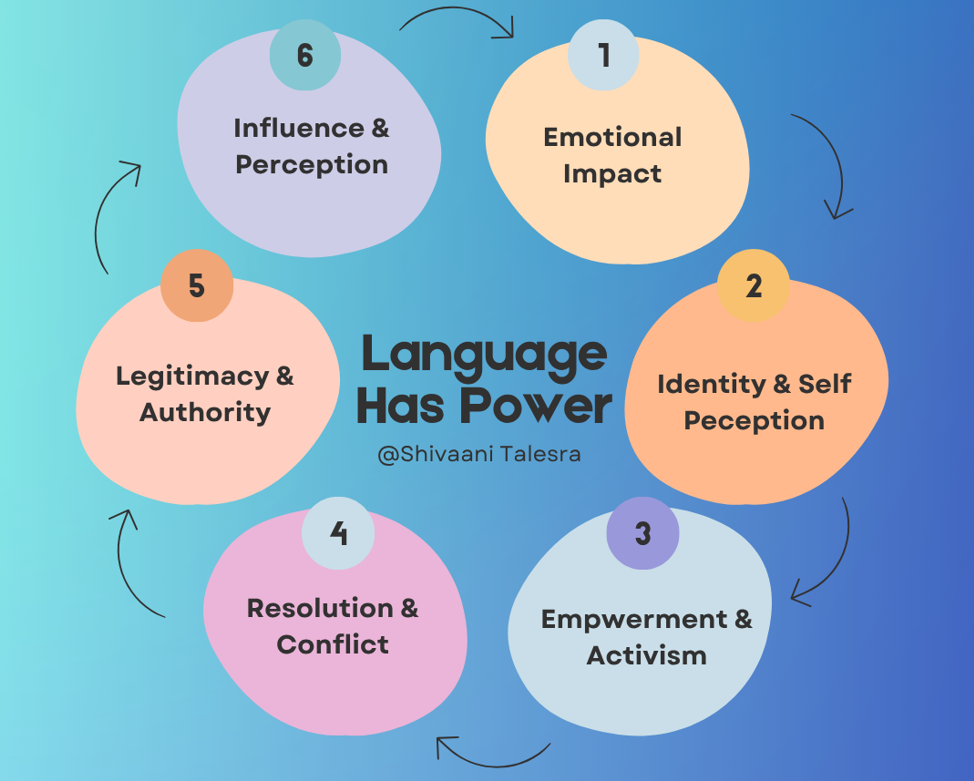
The most expensive thing a senior leader does every day isn’t their strategy. It’s their vocabulary.
May 2026 | BY SHIVAANI TALESRA
What the Coaching Room Reveals
In over two decades of working with senior leaders — business heads, directors, and those stepping into executive roles, I have noticed something that rarely makes it into leadership development conversations.
The leaders who plateau, who lose their best people quietly, who find themselves increasingly isolated at the top — they are rarely incompetent. They are often highly capable, experienced, and well-intentioned.
What derails them is something far subtler: the language they use without realising it.
Not the formal communication. Not the town halls or the strategy decks. But the micro-language — the reflexive responses, the habitual phrases, the tiny linguistic choices made in the middle of a difficult conversation — that reveal, often more accurately than any 360 reviews, what a leader truly believes about themselves, their people, and their organisation.
And here’s what makes this so difficult to address: nobody tells them.
At the executive level, the higher you rise, the more filtered your reality becomes. Teams naturally soften the truths they bring to your desk. Your casual comments land as directives. Your defensive responses read as cultural signals. You are projecting a leadership persona you may not recognise — one that is quietly costing you trust, talent, and organisational momentum.
This blog is an invitation to look at that persona honestly. Not as a criticism, but as a mirror.
The Numbers Behind the Silence
Before we go deeper into the how, let me give you a sense of what’s at stake.
According to Gallup’s research, managers account for 70% of the variance in employee engagement. That means the single biggest driver of whether your team is engaged or disengaged is not strategy, compensation, or culture initiatives — it is the quality of leadership they experience daily. And leadership, at its most granular, is experienced through language.
Disengaged employees cost the world an estimated $8.8 trillion in lost productivity annually — roughly 9% of global GDP. In the US alone, the figure runs to $450–$550 billion each year. Closer to home for most leaders reading this: McKinsey’s research suggests a typical mid-size organisation could be losing $228–$355 million annually due to low engagement and turnover.
And yet, when organisations investigate the root cause of disengagement, they rarely arrive at leadership language as one of the primary levers. They look at processes, compensation, flexibility. They run engagement surveys.
Meanwhile, Google’s Project Aristotle — one of the most rigorous studies ever conducted on what makes teams effective, found that psychological safety was the single most important factor in team performance. And psychological safety, at its core, is built or eroded through the way leaders speak.
The gap between what leaders intend to communicate and what their teams experience is not a values problem. In most cases, it is a language problem.
Three Categories of Silent Leaks
In my coaching practice, I have observed linguistic and judgment patterns that act as what I call silent leaks — they drain trust, impact, and organisational energy long before a leader notices anything is wrong.
These tend to cluster into three categories.
1. Credibility Leaks — The Language of Insecurity
Leaders are often unaware that certain habitual phrases inadvertently signal self-doubt or a closed mind — precisely the opposite of what they intend.
Over-qualifying language is one of the most common. Phrases like “Just a quick thought…”, “I could be wrong, but…”, or ending statements with “Does that make sense?” when sharing a strategic view. Each one, individually, seems modest and collegial. Collectively, they telegraph a lack of conviction that erodes the team’s confidence in the direction being set.
The “I/We” imbalance is another tell. When celebrating wins, the language becomes “I drove this result.” When explaining failures, it shifts to “We had some challenges” or “The team missed the target.” This asymmetry, which most leaders genuinely don’t notice, signals a lack of accountability — and teams notice it acutely.
Defensive reframing, the habitual “Yes, but…” response to feedback — closes down dialogue in the room while sending a message that the leader’s perspective is the ceiling of the conversation. Over time, people simply stop bringing challenging ideas.
Absolutist language under pressure,”This always happens,” “We never get the support we need” — destroys nuance at exactly the moment it’s most needed, and damages the intellectual credibility of the leader using it.
2. Connection Barriers — The Perception of Hierarchy
These patterns create emotional distance — from teams, from clients, from the collaborative relationships that senior leaders most depend on.
Transactional dialogue is perhaps the most pervasive. The leader who opens every interaction with the agenda — skipping the human exchange that precedes productive conversation sends a message, repeated across thousands of interactions, that efficiency matters more than the person. Clients feel transactional rather than valued. Team members feel like resources rather than contributors.
The “Fixer” judgment, listening not to understand but to solve — is deeply embedded in many high-performing leaders who rose through technical or functional excellence. It silences diverse perspectives in the room because people quickly learn that what you’re looking for is the problem statement, not the conversation around it.
Dismissive validation is particularly insidious because it masquerades as listening. “I hear you, however…” is not acknowledgment — it is erasure. The word “however” retroactively invalidates everything that came before it. I coach leaders on this specific pivot constantly. The difference between “I hear you, however…” and “I hear you. And here’s what I’m holding alongside that…” is not semantic. It changes the entire relational dynamic of the conversation.
Intellectual elitism, dense corporate jargon, unnecessary acronyms, language that signals membership in an exclusive club of the senior — isolates clients/ teams and creates a quiet hierarchy in rooms that should feel collaborative.
3. Growth Stiflers — The Fixed Mindset in Action
The most expensive language leaks are not the ones that damage relationships. They are the ones that quietly close down the organisation’s capacity to evolve.
Risk-averse vocabulary, “We tried that before,” “That’s not how we do things here,” “The market isn’t ready” — is the linguistic expression of a fixed mindset dressed as organisational wisdom. When these phrases come from senior leaders, they don’t just reflect a perspective. They become culture. Innovation dies not in big, visible moments, it dies in these small linguistic foreclosures.
The expert trap, the belief that “I must have all the answers” — manifests in language as leaders who fill silence, close down questions, and subtly penalise uncertainty in others. The higher you go, the more dangerous this becomes, because the problems worth your attention are precisely the ones that don’t have clean answers.
Blame attribution, perceiving systemic failures as individual incompetence or intentional action — produces language that assigns fault rather than investigates cause. “Who let this happen?” versus “What variables led to this outcome?”, these are not the same question. The first triggers defensiveness and concealment. The second invites collective problem-solving. And the choice between them, made in a split second under pressure, tells the team everything about whether it is safe to be honest with you.
When Language Meets the Bottom Line
The patterns above are not abstract. In my work, I see them translate directly into concrete organisational costs.
Team morale and quiet quitting. When leaders notice errors immediately but rarely acknowledge consistent excellence — what I call the Spotlight Judgment — teams experience a slow erosion of motivation. They don’t raise their hands for the stretch project. They stop volunteering the idea that might not land. Over time, they do what is required and nothing more. Gallup’s data shows only 3 in 10 employees feel their opinions count at work. The leaders in those organisations aren’t bad people; they have often just never received feedback on the micro-language that made their teams feel invisible.
Client relationships and churn. Clients rarely leave because of a single bad outcome. They leave because of an accumulating pattern of feeling misunderstood, managed, or deprioritised. The leader who responds to a client complaint by explaining the internal process rather than first validating the frustration — communicates, without meaning to: “Our process matters more than your problem.” The leader who over-promises to appear competent (“Yes, we can absolutely do that by Friday”) without checking realistic capacity, and then misses the deadline, destroys trust incrementally. Clients spot these patterns. And they leave for competitors who make them feel like partners.
Innovation and strategic agility. Organisations where senior leaders routinely close down uncertainty, fill silence, and penalise those who don’t have immediate answers develop a culture of performance over candour. Teams present polished conclusions rather than honest assessments. Senior leaders receive filtered information precisely when they most need clarity. Decisions get made on incomplete pictures. The organisation moves slowly, and doesn’t always know why.
The “Mirror Invitation” — A Framework for Inquiry
The reason these patterns persist is not lack of intelligence or values. It is the absence of an objective mirror.
At the director and business head level, the organisational environment rarely provides honest reflection. The 360 processes, when it exists at all, is often filtered through a desire not to damage a senior leader’s confidence or create difficult HR conversations. Peers are competitors as much as collaborators. The team, as I mentioned earlier, adjusts its truth to what it believes leadership can receive.
This is where coaching creates the conditions for something different: a mirror invitation — a structured, non-judgmental inquiry that helps leaders see their linguistic patterns not as personal flaws, but as systemic blind spots with measurable impact.
In practice, this begins with observation before intervention. In early coaching sessions, I listen not just for what leaders say about their challenges, but for how they say it. The language they use to describe a difficult team member. The words they reach for when asked what’s not working. The reflexive response when given pushback in the session itself.
These linguistic fingerprints reveal, reliably, the underlying mindset architecture — the beliefs about control, safety, authority, and worth that are driving the outward behaviour.
The framework I use works on a simple but powerful logic: Trigger → Behaviour → Business Impact.
The internal trigger — fear of looking incompetent — produces the behaviour of defensive deflection (“Yes, but we already thought of that”) — which produces the business consequence of silenced innovation and clients who feel unheard.
The internal trigger — viewing a client as a revenue line rather than a relationship — produces the behaviour of transactional engagement — which produces the consequence of churn to a competitor who leads with partnership.
When leaders can see this chain clearly, and locate themselves honestly within it, the motivation for change shifts. It is no longer about being told they have a blind spot. It becomes about understanding the cost of that blind spot in business outcomes, they care about.
That shift, from defensive awareness to inspired inquiry, is where coaching becomes genuinely transformative.
A Self-Diagnostic: Where Are Your Leaks?
Before you arrive at the coaching conversation, here is a set of questions worth sitting with honestly. Not to judge, but to orient.
In your last difficult conversation with a team member, a peer, a client — did you listen to understand, or to respond?
When you received feedback recently, was your first instinct to explore it or to explain it away?
Do you know, from honest observation rather than assumption, how your team experiences your language under pressure?
When was the last time someone in your organisation told you something you didn’t want to hear — and then followed up with another uncomfortable truth?
If the answer to that last question is “I can’t remember,” that is itself the data.
The leaders I have seen make the most significant shifts are not the ones who came to coaching most polished. They are the ones who came most honest — willing to sit with the discomfort of seeing themselves as others experience them, and curious enough to ask: what is my language actually costing the people and the organisation I lead?
What Changes When Language Changes
I want to close with what I have witnessed on the other side of this work because the purpose of holding up the mirror is not to create self-criticism. It is to create possibility.
When leaders shift from defensive reframing to genuine curiosity, something changes in the room. People begin to bring more. The quality of information that reaches the top improves. Decisions become more grounded.
When leaders move from the fixer-judgment to the listening-to-understand mode, diverse perspectives start to surface. Ideas that would previously have died in someone’s head before the meeting ended begin to enter the conversation.
When the language shifts from blame attribution to collaborative inquiry — from “Who let this happen?” to “What can we learn from this?” — teams stop concealing mistakes and start solving them faster.
None of this is soft. All of it is strategic. And it begins with the willingness to take your own language seriously — not as a communication style preference, but as an organisational force that is either building or eroding the culture you say you want to lead.
Reflection Questions
As you think about your own leadership language, sit with these:
- What is your first instinct when challenged in a meeting? To explore the challenge, or to manage it? Notice the language that follows that instinct.
- When did someone last give you feedback that surprised you? What does it tell you about what your team is currently filtering before it reaches you?
- Which of the three leak categories — Credibility, Connection, or Growth — resonates most uncomfortably? That discomfort is information worth following.
- What does your language say about what you believe about your people? Not what you would say it says — what does it reveal?
- If your team could describe the experience of being in a conversation with you in three words, what would those words be? And what would you want them to be? That gap is where the work lives.
Shivaani Talesra is an ICF PCC and EMCC Senior Practitioner with expertise as an Executive & Leadership Coach, Senior Trainer & Facilitator, and HR/OD Consultant specialising in leadership development, intergenerational dynamics, and organisational culture transformation. With 20+ years of senior leadership experience, she helps leaders navigate growth, transition, and complexity — building the inner clarity and presence to lead with impact at every stage.
If this blog prompted honest reflection, that’s a beginning. The next step is a conversation. [Schedule a Confidential Discovery Call] | [Explore Executive Coaching Services]
Word Count: ~2,800 words | Reading Time: ~12 minutes