Why no one wants to be a manager anymore — and what organisations must do about it
April 10, 2025 BY SHIVAANI TALESRA
Two Conversations That Reveal Everything
Conversation 1: The Overwhelmed Manager
“Why is it so hard to be an effective manager?” Lorna asked me during a leadership development session.
I probed: “What do you mean by hard?”
She looked exhausted. “Work has increased. Team size has increased. Uncertainty and layoffs are constant. What’s the point anymore?”
Lorna is 42, a Director of Operations at a mid-sized tech company. Three years ago, she managed 9 people. Today? Eighteen direct reports after multiple restructuring rounds. She works 60-hour weeks. Her calendar is back-to-back meetings. She has no time for strategic thinking — just firefighting and damage control.
Her team respects her. But she’s drowning.
When offered a VP promotion last quarter, she turned it down.
“What’s the point of a bigger title if it means even more pressure, less time for actual leadership, and watching more people burn out under me?”
Conversation 2: The Disinterested High Performer
Denis is 28, a senior individual contributor at the same company. High performer. Consistently exceeds goals. His manager sees him fit for “future leadership roles.”
I asked him about his career trajectory. “Are you interested in the promotion path? Moving into management?”
He didn’t hesitate. “No. I don’t want it.”
I sensed there was more beneath the surface. “Can you say more about that?”
“Why would I want to be like the senior guy? They are stressed. Works weekends. Their team complains about them behind their back. I make good money. I like my work. Why would I trade that for… that?”
This isn’t laziness or lack of ambition.
It’s clarity.
The Data Confirms What We’re Seeing
These aren’t isolated stories. They reflect a seismic shift happening across organizations globally.
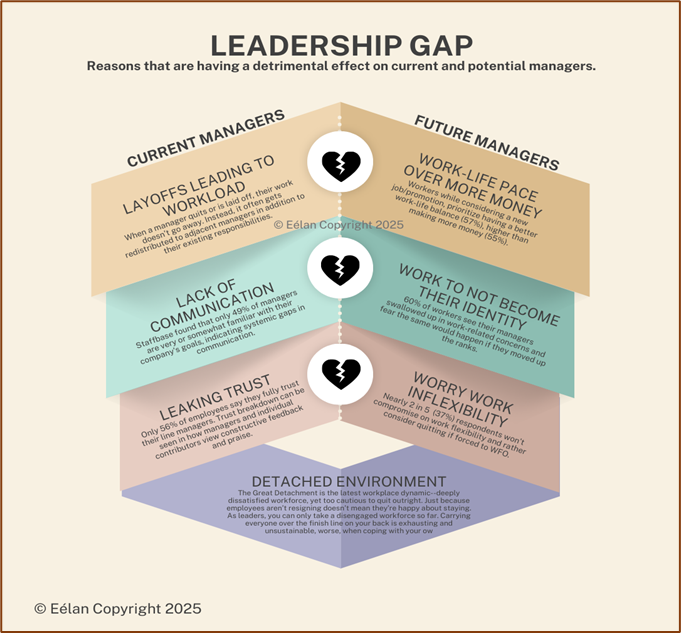
Current Managers: Surplus Struggling
The data on managers is alarming:
- 81% of senior-level managers have more direct reports than they did three years ago
- 71% report increased workloads with no corresponding increase in resources or support
- 6 in 10 managers feel overwhelmed, and more than 50% say their mental wellbeing has deteriorated
- Managers at various levels are being laid off in favour of “less centralised team structures”, which has resulted in crushing pressure on those who remain
Translation: The managers still standing are doing the work of two or three people. And they’re breaking under the weight.
Future Managers: Deficit Disinterested
On the other side, the talent pipeline that should be stepping into leadership roles? They’re walking away.
A 2024 Randstad study revealed shocking statistics:
- 34% of employees never want to become managers. Not “not right now.” Never.
- 39% of individual contributors don’t want to be promoted at all
- 51% are content with no advancement if they like their current role
Let that sink in.
More than one-third of your workforce has looked at management and said, “No, thank you.”
The Great Detachment: The Workplace Dynamic Defining Our Era
Beneath these statistics lies something even more troubling: The Great Detachment.
This isn’t quiet quitting. It’s not even the Great Resignation.
It’s something more insidious: A deeply dissatisfied workforce that’s too cautious to quit outright.
People are:
- Staying in roles they’ve outgrown because job market uncertainty makes jumping feel risky
- Going through the motions, delivering “good enough” work, but not investing emotionally
- Watching from the sidelines as leadership roles become less and less appealing
The result? Organisations filled with people who are physically present but mentally and emotionally checked out. And when those people are asked to step into leadership? They decline.
Why would they take on more responsibility in a system they’re already detached from?
The Leadership Gap: Surplus Struggling / Deficit Disinterested
This is the leadership gap we’re facing:
Too few people are willing to lead. And those who are leading are burning out.
Surplus of struggling managers. Leadership roles have become so unsustainable that even capable, experienced leaders are questioning whether it’s worth it.
Deficit of interested successors. The pipeline of future leaders is drying up because the next generation has watched what leadership can cost — and they’re opting out.
This isn’t a recruitment problem. This isn’t a training problem.
This is a systemic failure to make leadership sustainable, meaningful, and aligned with what today’s workforce values.
Why Leadership Became Unattractive
To understand this crisis, we need to ask: Why did leadership — once coveted and courted — become something people actively avoid?
1. The Broken Promise
For decades, the leadership narrative was simple:
“Work hard. Prove yourself. Get promoted. Earn respect, influence, and financial security.”
That promise is broken. Today’s reality:
- Promotions come with more work, but also with a lack of clarity and a lot more complexity
- Leadership doesn’t guarantee job security (managers are laid off just as quickly as ICs)
- Respect and influence? Often diluted by bureaucracy, politics, and a lack of real authority
What younger generations learned: The “corner office” isn’t the destination anymore. It’s a trap.
2. The Visibility of Burnout
Gen Z and younger Millennials grew up watching their parents, older siblings, and mentors burn out chasing leadership. They saw:
- Managers working nights and weekends, missing family events
- Leaders were laid off despite years of loyalty and sacrifice
- The mental and physical health toll of chronic stress
And they made a rational calculation: “If that’s what leadership looks like, I don’t want it.”
This isn’t entitlement. It’s pattern recognition.
3. Redefining Success
For Baby Boomers and Gen X, success often meant: title, authority, and financial achievement.
For Millennials and Gen Z, success means: autonomy, flexibility, purpose, and fulfilment.
Leadership used to signal success. Now it signals sacrifice.
The question isn’t “How do I climb the ladder?” anymore.
It’s “Why would I climb a ladder that leads somewhere I don’t want to go?”
4. Trust Erosion
Leadership requires trust — in the organization, in the system, in the promise that smart work will be rewarded. But trust gets eroded by:
- Mass layoffs (even high performers aren’t safe)
- Lack of transparency (decisions made behind closed doors)
- Inconsistent values (companies talk about wellbeing while rewarding overwork)
Growing leaders grapple with uncertainty and the ‘why’ to put in extra efforts.
5. The Manager Role Is Structurally Changing
Even those who want to lead effectively are not able to — because the role itself seems unsustainable.
What managers are expected to do:
- Develop their team members (coaching, feedback, career development)
- Execute strategic priorities (planning, decision-making, resource allocation)
- Manage up (reporting, aligning with senior leadership)
- Manage laterally (cross-functional collaboration)
- Handle administrative tasks (approvals, budgets, compliance)
- Be available for their team (1:1s, problem-solving, morale)
What managers actually spend time on:
- Back-to-back meetings
- Putting out fires
- Trying not to lose their best people
The gap between expectation and reality is why good managers are leaving — and why talented ICs are refusing to step in.
The Intergenerational Divide (That’s Not Just Generational)
This is often framed as a generational issue: “Gen Z just doesn’t want to work hard.”
But that’s both wrong and unhelpful.
The truth: This isn’t just Gen Z rejecting leadership. Millennials in mid-management are too.
Many Millennials took leadership roles in their late 20s and early 30s, expecting:
- Autonomy to make decisions
- Strategic impact
- The ability to shape culture and direction
Instead, they got:
- More meetings, less thinking time
- Accountability without authority
- Squeezed between unrealistic senior leadership demands and exhausted, burned-out teams
And now? Are they unknowingly giving a message to Gen Z: “Don’t do what I did. It’s not worth it.”
This isn’t generational defiance. It’s rational career planning based on observed reality.
The Real Divide Isn’t Age — It’s Values
The divide isn’t between Baby Boomers and Gen Z.
It’s between:
- Those who believe work should be the centre of identity, sacrifice is noble, and leadership is the ultimate validation
- And those who believe work is part of life (not all of it), boundaries are healthy, and leadership should enhance life, not consume it
Both perspectives are valid. But organisations built on the first assumption are struggling to attract and retain talent operating from the second.
What Organisations Are Getting Wrong
In response to the leadership gap, many organisations are trying traditional solutions:
What They’re Doing:
- Offering higher salaries for managers — hoping compensation offsets the workload
- Running leadership development programs — training people for roles they don’t want
- Forcing rotations into management — requiring high performers to “try management” as part of career progression
- Promoting based on technical skill — assuming great ICs will automatically become great managers
Why These Solutions Fail:
Higher pay doesn’t fix burnout. If the role is unsustainable, more money just makes it an expensive, unsustainable role.
Training doesn’t address motivation. You can teach someone how to be a manager. You can’t train them to want to be one.
Forced rotations create resentful leaders. People who are pushed into leadership reluctantly rarely thrive — and their teams suffer.
Technical skill ≠ leadership capability. The best engineer, salesperson, or analyst isn’t automatically equipped to lead people. And many don’t want to.
The fundamental problem: Organisations are trying to make an unattractive role slightly more palatable instead of asking:
“Why did leadership become unattractive in the first place?”
The Cost of This Gap (For Organisations)
This isn’t just a “people problem.” It’s a business-critical crisis leading to Immediate Costs:
Leadership Pipeline Crisis
No succession planning. When current leaders leave (or burn out), there’s no one ready to step in. Critical roles stay vacant for months.
Talent Drain
High-potential employees leave because they see no appealing path forward. They take their skills, knowledge, and network to competitors — or to industries that offer better work-life integration.
Manager Burnout and Turnover
Overworked managers burning out and leaving creates a vicious cycle: their departures add even more pressure on the managers who remain.
Long-Term Costs:
Innovation Stalls
No one wants to take ownership of bold initiatives. Safe, incremental thinking becomes the norm.
Decision-Making Bottlenecks
With fewer managers and larger spans of control, decisions wait. Agility disappears, and the organisation moves more slowly than its competitors.
Culture Erosion
Disengaged, overwhelmed managers create disengaged teams. Culture suffers when the people responsible for shaping it are too burned out to care.
Competitive Disadvantage
Organisations with healthier leadership models — where leading is sustainable and fulfilling — will attract the best talent and outpace you.
What Needs to Change: Five Strategic Shifts
Organisations that want to close the leadership gap must stop trying to fix the symptoms and start addressing the root causes.
Here are five strategic shifts that can make leadership appealing, sustainable, and impactful again.
Shift 1: Redefine What Leadership Means
From: Authority, title, control, corner office
To: Impact, influence, growth, purpose
Leadership doesn’t have to mean only people management. Some of the most impactful leaders in organisations are:
- Senior ICs driving innovation and mentoring others
- Project leaders influencing outcomes without formal authority
- Culture champions shaping how teams work together
What this looks like in practice:
- Create clear IC leadership tracks where people can advance in seniority, compensation, and influence while managing teams.
- Recognise and reward leadership behaviours (mentoring, cross-functional collaboration, strategic thinking) — not just leadership titles.
- Stop equating management with career success.
Shift 2: Make the Manager Role Sustainable
If you want people to step into management, the role has to be more realistic.
Manageable span of control
Depending on work, industry and context, managers should have 10-15 direct reports. Research shows the ideal range is 5-8 for hands-on coaching and development. Beyond that, managers become administrators, not leaders.
Protect time for actual leadership
Block calendar time for:
- Strategic thinking (not just reacting)
- Coaching and development (not just performance reviews)
- Relationship-building (internal and external)
Give managers real authority, not just accountability
If managers are accountable for results but can’t make decisions (hiring, budget, priorities), they’ll feel powerless. Authority and accountability must match.
Invest in manager development
Managers need coaching, peer support networks, and mental health resources. Stop treating management as a “figure it out yourself” role.
Shift 3: Model Healthy Leadership at the Top
If your senior leaders are visibly burned out, working always on the go, and sacrificing health and relationships — that’s the model you’re selling to the next generation.
They can flip the script by changing their practice:
Senior leaders who work reasonable hours and talk openly about boundaries.
Leaders who prioritise the well-being of their own and their teams.
Leaders who show vulnerability — admitting when they’re overwhelmed, asking for help, and modelling resilience.
Stop glorifying overwork — No more “hustle culture” or badges of honour for who works till the last.
The message must be: You can lead effectively and have a life. It’s not either/or.
Shift 4: Create Multiple Pathways to Influence
Not everyone is apt to become a people manager. And that’s okay.
What this requires:
Build robust IC tracks
Create senior IC roles (Principal, Distinguished, Fellow) with compensation and influence equivalent to management tracks.
Enable project-based leadership
Let people lead initiatives, task forces, and strategic projects without permanently moving into people management.
Value different types of leadership
- Technical leadership (setting standards, mentoring, driving innovation)
- Thought leadership (shaping strategy, bringing new ideas)
- Cultural leadership (modelling values, building psychological safety)
When people can lead in ways that align with their strengths and values, more will say yes.
Shift 5: Address the Root Causes of Detachment
The Great Detachment isn’t just about leadership. It’s about a workforce that’s losing trust in the system.
What this requires:
Transparency in decision-making
When layoffs happen, when strategies shift — explain why. People can handle hard truths. They can’t handle feeling misled.
Consistency between values and actions
If you say people matter, don’t lay off thousands while giving executives bonuses. Make it planned, distributed with proper reasoning. Align actions with stated values.
Meaningful work and purpose
Help people see how their work connects to impact. When work feels meaningless, detachment is inevitable.
Psychological safety
Create environments where people can speak up, challenge, and be honest without fear of retaliation.
When trust is rebuilt, engagement returns. And engaged employees are far more likely to step into leadership.
Why Navigating Such Situations Requires Organisational Consulting and Strategic Communication
This isn’t about the “change email” going from top management. It requires deep organisational change work.
Through Facilitated Intergenerational Dialogues:
Organisations need structured conversations across generations to:
Help Baby Boomers and Gen X understand why younger leaders think differently — not as defiance or laziness, but as different values shaped by different experiences.
Create space for Gen Z and Millennials to voice what they need from leadership roles — without judgment or defensiveness.
Build a shared language around what leadership should look like moving forward — blending the strengths of different generational perspectives.
Strategic facilitation provides:
- Neutral ground where honest conversation can happen
- Frameworks to understand generational differences without stereotyping
- Action plans co-created by the people who will live them
Through Organisational Development Consulting, decision makers can take this structural work beyond just conversations:
Redesigning leadership structures
- Reducing spans of control
- Building IC leadership tracks
- Creating project-based leadership opportunities
Succession planning that acknowledges reality
- Identify those who want to move into management
- Identify multiple types of leadership potential
- Build development paths for diverse leadership styles
Culture interventions
- Making leadership sustainable, not soul-crushing
- Modelling healthy leadership from the top
- Rebuilding trust and psychological safety
Consulting provides:
- Data-driven diagnosis of where the gaps are
- Strategic roadmaps for systemic change
- Implementation support to ensure changes stick
Through Leadership Development — With a Twist
Traditional leadership programs teach: “How to be a manager.”
What’s needed now: “How to lead in ways that align people, process, purpose and plot (context) — and without burning out.” What this looks like:
For Emerging Leaders:
- Helping them see they can lead differently than the broken models they’ve witnessed
- Building leadership capability and sustainable habits from the start
- Exploring: “What kind of leader do they want to be?” not just “How do I do this job?”
For Current Managers:
- Helping them reclaim time, energy, and strategic focus
- Teaching them to delegate, empower, and build self-sufficient teams
- Addressing burnout before it becomes resignation
The integration of consulting, strategic communication and leadership development creates systemic, sustainable change — not just band-aid solutions.
Real Voices: What Needs to Happen
Let’s return to Lorna and Denis — and what they told me needs to change.
Lorna’s Reflection:
After months of coaching and organisational intervention, Lorna’s company realigned manager spans of control and enabled them to curate “strategy days” — calendar blocks protected from meetings.
She said:
“For the first time in three years, I have space to think. I’m not just reacting. I can actually develop my team, plan ahead of time, and lead the way I know I should. I’m not sure I would have stayed much longer if nothing changed.”
Denis’s Reflection:
When his company introduced senior IC tracks with real influence and competitive compensation, Denis reconsidered his stance on leadership.
“I realised I don’t dislike leadership. I was very uncomfortable with that version of leadership, which got exaggerated in my mind. Now I can see myself leading projects, mentoring others, driving strategy — without becoming the guy who loses himself in the process. That’s a path I’d actually want.”
The Question for 2026 and Beyond
The question is no longer: “How do we find the best leaders?”
The question is: “How do we inspire our talent to reach their leadership potential?”
And the answer isn’t better recruiting or higher salaries.
The answer is making leadership sustainable, meaningful, and aligned with what people actually value.
Organisations that figure this out will thrive. Those that don’t will face a perpetual leadership crisis — and watch their best talent walk away.
Reflection Questions for Organisations and Leaders
As you think about the leadership gap in your organisation, ask yourself:
- Are we treating the leadership pipeline crisis as a “people problem” or as a “systemic design problem”?
- What does leadership cost in our organisation? (Not just salary — time, health, relationships, wellbeing)
- If we’re honest, would we want the manager roles we’re asking others to step into?
- Are we rewarding healthy, sustainable leadership — or glorifying overwork and burnout?
- What would it take to make leadership appealing to the next generation — not by lowering standards, but by redesigning the role?
Ready to Bridge the Leadership Gap?
If your organisation is struggling with leadership pipeline challenges, manager burnout, or disengaged talent unwilling to step into leadership roles, you’re not alone. But you don’t have to stay stuck.
For Organisations:
We design facilitated intergenerational dialogues to help bridge the divide between generations, creating shared understanding and co-created solutions.
Our organisational development consulting services can support redesigning leadership structures, succession planning, and culture to make leadership sustainable and appealing.
Our leadership development programs equip current and emerging leaders with the tools to lead effectively and sustainably — modelling a new way forward.
Let’s Talk:
This isn’t a quick fix. But it’s the work that will define your organisation’s future. Let’s explore how we can help you close the leadership gap and build a culture where people want to lead — because leadership is meaningful, impactful, and sustainable.
Schedule a Consultation
Explore Our Facilitation Programs
Learn About OD Consulting Services
About the Author:
Shivaani Talesra is an ICF PCC and EMCC Senior Practitioner with expertise as an Executive & Leadership Coach, Senior Trainer & Facilitator, and HR/OD Consultant specialising in intergenerational dynamics, leadership development, and organisational culture transformation. With 20+ years of senior leadership experience, she helps organisations navigate the evolving landscape of leadership and build sustainable models for the future.
Key Takeaways
- Current managers are drowning (81% more reports, 60% overwhelmed); future leaders are declining (34% never want to manage).
- The Great Detachment: deeply dissatisfied workforce too cautious to quit.
- Leadership became unattractive due to broken promises, burnout visibility, trust erosion, and structural dysfunction.
- This isn’t generational defiance — it’s rational career planning based on observed reality.
- Five strategic shifts needed: Redefine leadership, make management sustainable, model healthy leadership, create multiple pathways, and address detachment.
- Solutions require facilitation, OD consulting, and reimagined leadership development.
Word Count: 4,500 words
Reading Time: 18-19 minutes