Great decisions are not only about speed and solutions — they’re also about impact
OCTOBER 21, 2025 BY SHIVAANI TALESRA
The Pressure to Decide Fast
In today’s business environment, leaders are under constant pressure to decide quickly.
“We need an answer by the end of the day.”
“The competition is moving — we can’t wait.”
“If we don’t decide now, we’ll miss the window.”
Speed has become the default measure of strong leadership. Hesitate, and you’re seen as indecisive. Pause to reflect, and you’re accused of overthinking.
But here’s what this “move fast” culture doesn’t tell you:
Fast decisions without thoughtful questioning often become expensive mistakes.
And the cost? It’s not just financial.
The Real Cost of Bad Decisions
When leaders make decisions without adequate reflection and questioning, the consequences ripple far beyond the immediate outcome.
Business Cost:
Think about the high-profile decision failures we’ve witnessed:
- Kodak had digital camera technology in 1975 but chose not to pursue it, fearing it would cannibalise film sales. That decision cost them their industry dominance.
- Blockbuster turned down the opportunity to buy Netflix for $50 million in 2000, dismissing streaming as a niche market. Within a decade, Blockbuster was bankrupt.
- Nokia saw the iPhone coming but decided its existing strategy was sufficient. They lost 90% of their market value in just a few years.
These weren’t failures of intelligence or resources. They were failures of questioning.
No one asked: “What if we’re wrong about this?” or “What alternatives are we not seeing?”
Personal Cost to Leaders:
Bad decisions erode more than business outcomes:
- Credibility loss — Your team questions your judgment on future decisions
- Decision fatigue — You second-guess every choice, creating paralysis
- Stress and overwhelm — The weight of “getting it wrong” becomes crushing
- Career impact — Major missteps can derail years of progress
Team Cost:
When leaders make poorly thought-out decisions:
- Confusion — The team doesn’t understand the rationale and loses faith in leadership
- Loss of trust — People stop believing you’re making decisions in their best interest
- Decision fatigue — Constant pivots and reversals exhaust the organization
- Disengagement — Why invest energy if the strategy might change tomorrow?
The uncomfortable truth: You can’t afford to get big decisions wrong. But you also can’t afford to rush them.
The Shift Leaders Need to Make
Here’s what coaching and mentoring reveal: The most effective leaders experience a profound shift in how they approach decisions.
From → To
Giving solutions → Seeking ideas
Instead of being the person with all the answers, great leaders encourage, invite and unlock collective intelligence.
Telling what to do → Asking the right questions
Leadership isn’t about instructing every next move. It’s about asking the questions that create the conditions for the best answer to emerge.
Current success → Sustainable success
Short-term wins that compromise long-term viability aren’t success. They’re just delayed failures.
This shift requires something most leaders haven’t been taught: The art of powerful questioning.
Why Questions Matter More Than Speed
Effective decision-making is both an art and a science.
The science: Data, analysis, modelling, risk assessment
The art: Asking the questions that reveal what data alone can’t show
Questions force you to:
- Challenge your assumptions
- Explore blind spots
- Consider second-order consequences
- Think beyond the immediate
And most importantly, questions create space for wisdom to emerge — even under pressure.
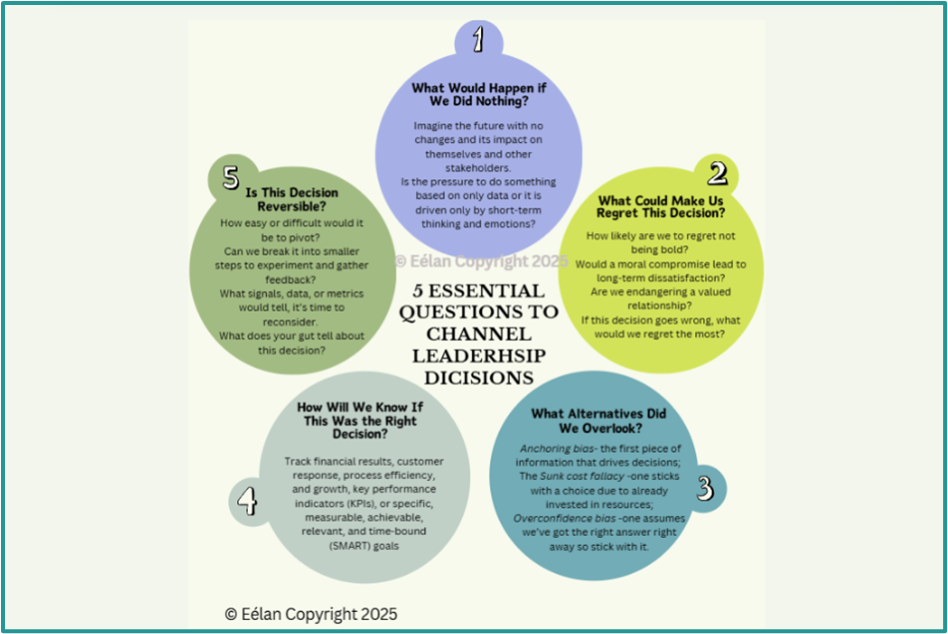
The Five Essential Questions to Channel Leadership Decisions
Over years of facilitating leadership programs and coaching senior executives, I’ve identified five questions that consistently transform decision-making.
These aren’t theoretical. They’re battle-tested by leaders navigating complexity, ambiguity, and high stakes.
Question 1: What Would Happen if We Did Nothing?
This question forces leaders to evaluate the cost of inaction — which is often invisible until it’s too late.
Why This Matters: Most leaders focus on the risks of taking action. But they rarely calculate the risk of not taking action.
Inaction feels safe. It feels like you’re avoiding mistakes. But in a changing environment, standing still is moving backwards.
When Leaders Skip This Question:
- They assume the status quo is sustainable (it rarely is)
- They miss the opportunity cost of not moving
- They wait until a crisis forces reactive decision-making
- They lose strategic windows that won’t reopen
Real Example:
A mid-sized retail company debated investing in e-commerce infrastructure in 2015. The CEO said:
“Our stores are doing fine. We have loyal customers. Why risk disruption and the massive investment?”
They chose inaction. Sales continued steadily for three years. Leadership felt validated.
Then 2020 hit. The pandemic forced them online overnight. But their competitors had a five-year head start.
The cost?
- Emergency digital transformation at 3x the original estimated cost
- Market share erosion, they couldn’t recover
- Layoffs because they couldn’t pivot fast enough
- Brand damage as customers experienced a clunky, rushed online experience
If they’d asked Question 1 in 2015: “What happens if we don’t invest in e-commerce and consumer behaviour shifts?”
The answer would have been clear: Inaction was the riskier bet.
How to Apply This Question:
When facing a decision, ask:
- What are the mid-term and long-term consequences of maintaining the status quo?
- What market forces, technology shifts, or competitive moves might make inaction costly?
- What opportunities will we miss if we don’t act now?
- When preparation meets opportunity, luck shows up — but only if we prepare.
Sometimes the biggest risk is not taking one.
Question 2: What Could Make Us Regret This Decision?
This question brings future consequences into present awareness — helping you avoid choices you’ll wish you hadn’t made.
Why This Matters: Regret is a powerful teacher, but it’s expensive. Better to anticipate it than experience it.
Research shows regrets typically fall into four categories:
Foundation regrets: Poor foundational choices (health, finances, education)
Boldness regrets: Missed opportunities or failure to take calculated risks
Moral regrets: Compromising values, ethics, or integrity
Connection regrets: Strained or lost relationships
Understanding which type of regret you risk helps you make better choices.
When Leaders Skip This Question:
- They optimise for short-term wins that create long-term problems
- They make decisions that feel good today but erode trust, health, or values
- They sacrifice relationships for results — and later realise the cost
- They fail to consider how they’ll feel about this decision 1, 5, or 10 years from now
Real Example:
A VP of Sales was offered an aggressive growth target with a significant bonus attached. The catch? It required pushing products the team knew weren’t the right fit for certain customer segments.
They didn’t pause to ask: “What could make me regret this?”
They hit the target. Got the bonus. Six months later, customer churn spiked. Her team’s morale plummeted because they felt they’d misled clients. Their reputation took a hit.
When we worked together in coaching, they said:
“I knew it felt wrong. But I told myself it was just business. Now I realise — I traded my integrity for a bonus. That’s the definition of a bad decision.”
If they had asked Question 2, they might have negotiated different targets or pushed back on the strategy. The short-term gain wasn’t worth the long-term cost.
How to Apply This Question:
When facing a decision, ask:
- Is this choice aligned with my values and the kind of leader I want to be?
- What’s the physical, mental, and financial health impact of this path?
- Am I making a sound long-term choice, or am I optimising for short-term relief?
- What relationships might be damaged by this decision?
- Have I made similar decisions before that led to regret? What patterns am I repeating?
The decisions you’ll be proud of 10 years from now.
Question 3: What Alternatives Did We Overlook?
This question disrupts bias and opens up possibilities you didn’t see at first glance.
Why This Matters:
Human brains are wired for confirmation bias — we favour information that supports what we already believe.
Add to that:
- Groupthink (teams settling on a course of action to avoid conflict)
- Availability bias (overweighting the most recent or memorable information)
- Anchoring bias (fixating on the first option presented)
All of these narrow your field of vision. You think you’re seeing all the options. But you’re only seeing the options your biases allow.
When Leaders Skip This Question:
- They treat decisions as binary (Option A or Option B) when a third path exists
- They miss creative solutions because they stopped exploring too soon
- They fall into groupthink because no one challenged the consensus
- They optimise for the wrong goal because they didn’t question the framing
Real Example:
A technology company faced declining product adoption. The leadership team debated two options:
Option A: Double down on sales and marketing to push the existing product
Option B: Pivot to a completely new product line
The debate became heated. The team was split. Decision paralysis set in.
In a facilitation session, I asked: “What alternatives are you not seeing?”
Silence. Then one product manager said:
“What if we’re solving the wrong problem? What if adoption is low, not because the product is bad, but because onboarding is confusing?”
That question unlocked a third path: Redesign the user experience and onboarding flow — far less risky and expensive than either original option.
They implemented it. Adoption increased 40% in three months. No new product. No massive marketing spends. Just a solution they’d overlooked because they’d framed the problem incorrectly.
How to Apply This Question:
When facing a decision, ask:
- Are we treating this as binary when other options exist?
- What would someone outside this situation suggest?
- What are we not considering because of our biases or blind spots?
- Who has a different perspective we haven’t consulted?
- If we had unlimited resources, creativity, and time — what would we do?
The options hiding in your blind spots.
Question 4: How Will We Know if This Was the Right Decision?
This question forces clarity on what success actually looks like — before you commit.
Why This Question Matters:
It’s impossible to make a good decision if you’re not clear about what “good” means.
Too many leaders make decisions based on vague goals:
- “We want to grow.”
- “We need to improve culture.”
- “This will be better for the team.”
Without clear success criteria, you can’t evaluate whether the decision was right, which means you can’t learn and improve.
When Leaders Skip This Question:
- They move forward with misaligned expectations (everyone thinks success means something different)
- They declare victory prematurely (based on feelings, not data)
- They fail to course-correct because they’re not tracking the right metrics
- They can’t learn from the decision because they never defined what success was
Real Example:
A CEO decided to implement a new performance management system. When I asked, “How will you know if this was the right decision?” they said:
“People will be happier and more engaged.”
I pushed: “How will you measure that? What’s the baseline? What’s the target? By when?”
Pause. They realised: They hadn’t thought it through.
We created a measurement framework:
- Baseline: Current engagement score (62%)
- Target: 75% within 12 months
- Leading indicators: Manager feedback quality, goal clarity scores, 1:1 frequency
- Review cadence: Quarterly pulse checks
Eighteen months later, engagement hit 78%. But more importantly, they knew why it worked — because they’d tracked the leading indicators and could replicate the approach.
How to Apply This Question:
When facing a decision, ask:
- What does success look like in 3 months? 6 months? 12 months?
- What are the quantitative and qualitative measures of success?
- What leading indicators will tell us if we’re on track (before it’s too late to adjust)?
- How will we review progress? Who’s responsible for tracking?
- What will we do if early signals suggest this isn’t working?
Whether you’re making a real decision or just hoping for the best.
Question 5: Is This Decision Reversible?
This question reduces the pressure to be “perfect” and creates space for iteration and learning.
Why This Question Matters:
In a world of rapid change, the ability to test, learn, and adjust is more valuable than getting it right the first time. But leaders often treat every decision as irreversible, which creates decision paralysis and risk aversion.
The truth? Most decisions are more reversible than you think.
Understanding reversibility helps you:
- Move faster on low-risk decisions
- Invest more time in high-stakes, irreversible choices
- Adopt an experimental mindset (pilot, test, iterate)
- Reduce the fear that holds you back from bold moves
When Leaders Skip This Question:
- They over-invest time in decisions that don’t warrant it
- They under-invest time in truly irreversible decisions
- They miss opportunities because fear of being wrong stops them from trying
- They create a risk-averse culture where no one experiments
Real Example:
A startup founder debated launching a new product feature. They spent three months in analysis paralysis, worried it would confuse users or damage the brand.
I asked: “What if you launched it to 10% of users as a beta test? Is that reversible?”
They paused. “Yes. Completely. We could turn it off in a day if it’s a disaster.”
Within two weeks, the beta was live. User feedback was mixed but insightful. They iterated. Three months later, the feature was a core part of the product.
The lesson: They have been treating a reversible decision as if it were permanent — and it cost them three months of potential learning.
How to Apply This Question:
When facing a decision, ask:
- If this doesn’t work, can we reverse it? What would that cost?
- Can we test this on a small scale before full commitment?
- What’s the worst-case scenario if we move forward and it fails?
- Are we treating this as irreversible when it’s actually not?
- What would a “pilot” or “experiment” version of this decision look like?
Where you can move boldly and where you need to tread carefully.
Common Decision-Making Traps (And How Questions Guard Against Them)
Even smart, experienced leaders fall into predictable decision-making traps. Here are the most common — and how the 5 Essential Questions protect you.
Confirmation Bias
The trap: You seek data that supports what you already believe, ignoring contradictory evidence.
The antidote: Question 3 (What alternatives did we overlook?) forces you to consider perspectives that challenge your assumptions.
Sunk Cost Fallacy
The trap: You continue a failing course of action because you’ve already invested so much (time, money, reputation).
The antidote: Question 2 (What could make us regret this?) helps you see that continuing down a bad path leads to even bigger regret.
Groupthink
The trap: Your team agrees too quickly to avoid conflict, missing critical blind spots.
The antidote: Question 3 (What alternatives did we overlook?) creates psychological safety to challenge consensus.
Analysis Paralysis
The trap: You gather more data, run more models, delay deciding — until the window closes.
The antidote: Question 5 (Is this reversible?) helps you distinguish between decisions that warrant deep analysis and those that can be tested quickly.
Recency Bias
The trap: You, overweight recent events and make decisions based on short-term data, not long-term trends.
The antidote: Question 4 (How will we know if this was right?) forces you to define success over multiple time horizons, not just immediate results.
Real-World Transformation: Ana’s Story
Let me share a coaching journey that illustrates the power of these questions.
Meet Ana, the CEO of a growing SaaS company. She faced a critical decision: whether to pivot her company’s product strategy mid-year. The pressure was intense.
- The board wanted clarity and speed
- Her sales team wanted to stay the course (they’d just trained on the current product)
- Her product team believed the market was shifting, and a pivot was essential
Ana felt paralysed — not because she lacked information, but because every option felt risky. The weight of “what if I’m wrong?” was crushing.
In our coaching session, we walked through the 5 Essential Questions.
Q1: What if we did nothing?
Ana’s initial instinct: “Staying the course feels safer. We know this product works.”
But when she explored the cost of inaction, clarity emerged:
- Competitors were moving into adjacent markets
- Customer feedback indicated shifting needs
- The sales team’s current success was based on relationships, not product-market fit
Realisation: Doing nothing meant slow decline. It felt safer, but it wasn’t.
Q2: What could make us regret this?
Ana identified two regret scenarios:
Regret A: “If we pivot and fail, we lose credibility with customers and the board.”
Regret B: “If we don’t pivot and the market passes us by; we lose the company.”
Realisation: Both paths had regret risk. But one was existential. The other was recoverable.
Q3: What alternatives did we overlook?
This question unlocked everything.
Ana had been thinking binary: Pivot or don’t pivot.
But a third option emerged: Pilot the new strategy with one customer segment before full rollout.
This allowed her to:
- Test the market without betting the company
- Get real customer data, not just internal assumptions
- Keep the sales team focused while the product is being experimented with
- Preserve optionality
Realisation: She didn’t have to choose between all or nothing.
Q4: How will we know if this was right?
Ana defined clear success metrics for the pilot:
- Customer adoption rate: 60% of pilot customers actively using new features within 60 days
- Revenue impact: 20% increase in customer lifetime value for pilot segment
- Team confidence: Sales team feedback on whether they believe in the new direction
No guessing. Just measurable outcomes.
Q5: Is this reversible?
The pilot approach made it reversible.
If it didn’t work, they could:
- Return to the original strategy
- Apply learnings to refine the approach
- Make an informed decision about full pivot vs. stay
Realisation: The decision wasn’t as permanent as it felt. That reduced the pressure to be “perfect.”
The Outcome:
The pilot succeeded beyond expectations. Customer adoption hit 75%. Revenue impact exceeded targets.
They scaled the new strategy across the business. Revenue grew 30% in the next year.
But more importantly, Ana learned that great decisions aren’t about certainty. They’re about asking the right questions.
She now uses these questions with her leadership team for every major decision. And the quality of their strategic choices has transformed.
How Training/Facilitation Plays a Role
In leadership development programs, we bring experiential decision-making frameworks:
- Pros and cons analysis
- Scenario planning
- Risk assessment matrices
- Stakeholder mapping
Leaders leave with tools, templates, other top models and a lot of confidence.
But it is possible that in 6-8 weeks, they might revert to old ways of working.
Why?
Because decision-making under pressure isn’t just a skill gap. It’s rooted in how you handle uncertainty, doubt, and internal pressure.
And that requires more than frameworks. It requires self-awareness, emotional regulation, and an external perspective.
How an Integrated Approach Can Support: Training + Coaching
The most effective decision-making transformation happens when training and coaching work together.
Through Leadership Development Training:
Organisations can build decision-making capability across leadership levels through structured programs.
What training provides:
- Decision-making frameworks and methodologies
- The 5 Essential Questions (and how to apply them)
- Practice scenarios where leaders work through complex decisions together
- Peer learning (hearing how others approach decisions)
- Common language around effective decision-making
Training creates team alignment — everyone uses the same approach, reducing confusion and friction.
Through Executive Coaching:
While training builds the skill, coaching addresses the internal barriers.
Coaching helps leaders:
- Identify their decision-making patterns
- Work through the fear and doubt that clouds judgment
- Practice asking powerful questions in real-time/actual decisions
- Build accountability for their own decision criteria
- Reflect on past decisions to identify what works and what doesn’t
A coach creates space for honest exploration that your team can’t provide — because they have too much at stake in your decisions.
Why Both Matter:
- Training gives you the frameworks and questions
- Coaching helps you apply them under pressure, navigate internal resistance, and build sustainable habits
When you combine both, decision-making shifts from a source of stress to a leadership strength.
Reflection Questions for Leaders
As you think about your own decision-making approach, ask yourself:
- When facing big decisions, do I rush to solutions — or do I pause to ask powerful questions?
- Which of the 5 Essential Questions do I consistently skip?
- What decision-making traps do I fall into most often?
- If I’m honest, how many of my “urgent” decisions are actually urgent?
- What would change if I had a thinking partner who helped me question my assumptions before committing?
It’s Not About Guarantees — It’s About Sharpening the Skill
No framework, no set of questions, no coach can guarantee perfect decisions.
Leadership means navigating uncertainty. Making choices with incomplete information. Taking calculated risks.
But what these questions do is sharpen your decision-making skill — so that over time, you make better choices, learn faster from mistakes, and build the wisdom that comes from thoughtful practice.
Ongoing use of these questions helps you foster the habits you need for long-term growth and sustainable success.
Ready to Transform Your Decision-Making?
If you’re a leader navigating high-stakes decisions, complex trade-offs, or decision fatigue, you don’t have to figure it out alone.
For Organisations:
Our leadership development programs equip your teams with proven decision-making frameworks, powerful questioning techniques, and experiential practice to build confidence and capability.
For Individuals and Group Leaders:
Executive coaching provides the personalised, confidential space to work through real decisions in real-time — with a thinking partner who helps you see what you can’t see on your own.
Let’s talk about how we can help you make decisions with greater clarity, confidence, and impact.
Schedule a Confidential Discovery Call
Explore Our Leadership Development Programs
Learn About Executive Coaching
About the Author:
Shivaani Talesra is an ICF PCC and EMCC Senior Practitioner with expertise as an Executive & Leadership Coach, Senior Trainer & Facilitator, and HR/OD Consultant specialising in strategic decision-making, leadership effectiveness, and building organisational capability. With 20+ years of senior leadership experience, she helps executives and teams make decisions that drive sustainable success.
Key Takeaways
- Speed without thoughtful questioning leads to expensive mistakes.
- Great decisions require the discipline to pause and ask the right questions.
- 5 Essential Questions: What if we did nothing? What could make us regret this? What alternatives did we overlook? How will we know if this was right? Is this reversible?
- Questions act as guardrails against common decision-making traps.
- Training builds decision-making frameworks; coaching helps you apply them under pressure.
- Sustainable success comes from sharpening decision-making skills over time.
Word Count: ~5,200 words
Reading Time: 20-21 minutes