
The Risk of Doing Nothing
Successful leaders say yes to taking risks and innovation — not because they’re reckless, but because they understand a fundamental truth:
Doing nothing is a bigger risk than trying and failing.
In a world of constant disruption, standing still is moving backwards. Competitors are innovating. Markets are shifting. Customer expectations are evolving. Technology is advancing.
And if you’re relying on what worked yesterday to carry you through tomorrow, you’re already behind.
The arrogance of success is thinking that past wins guarantee future results. It’s assuming that the strategies, skills, and approaches that got you here will automatically take you where you need to go next.
They won’t.
Leadership Is More Than Managing Teams
We often think of leadership as a set of responsibilities: leading teams, directing projects, guiding strategy, and managing performance.
But that’s a limited view.
Leadership today is about cultivating an entrepreneurial mindset — regardless of your job title, function, or place in the organizational hierarchy.
Those who see themselves as simply having a job role, a company, and a timeline to deliver are lagging behind those who approach their work with an entrepreneur’s lens:
- Ownership over just execution
- Innovation over just maintenance
- Value creation over just task completion
- Strategic thinking over just tactical delivery
This mindset isn’t reserved for CEOs or business owners. It applies to every level — from business functions to enabling functions, from individual contributors to C-suite executives.
The depth and shape of this mindset vary, but the core principle remains: leaders who think like entrepreneurs drive growth, adaptability, and sustained impact.
What Is an Entrepreneurial Mindset?
At its essence, an entrepreneurial mindset is a perspective that leaders adopt to drive growth and adaptability by embodying traits like:
- Resilience — Bouncing back from setbacks without losing momentum
- Creativity — Seeing possibilities where others see obstacles
- Willingness to take calculated risks — Moving forward despite uncertainty
- Proactive problem-solving — Anticipating challenges before they become crises
- Ownership mentality — Acting as if the success or failure of the business depends on you
Leaders with an entrepreneurial mindset don’t wait for permission. They don’t hide behind “that’s not my job” or “we’ve always done it this way.” They embrace change, seek out opportunities, and inspire others to push boundaries.
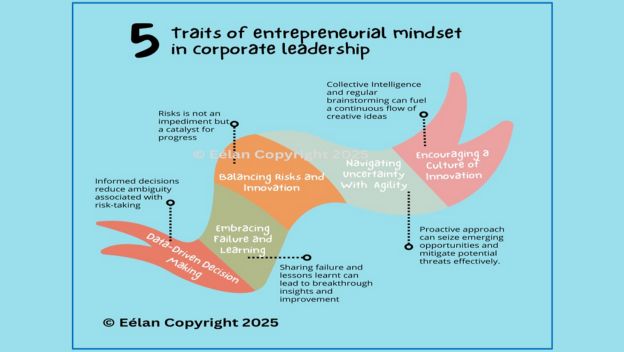
Five Traits of the Entrepreneurial Mindset in Corporate Leadership
Let’s break down what this actually looks like in practice.
- Balancing Risk and Innovation
Innovation is essential for growth and sustainability. But innovation inherently involves uncertainty and risk. Effective leaders understand that risk isn’t something to avoid — it’s something to manage strategically.
They encourage calculated risk-taking, aligned with the organization’s goals, values, and vision. They create a safe space for experimentation while mitigating the potential downsides of recklessness.
What this looks like in practice:
- Launching pilot programs before full-scale rollouts
- Allocating “innovation budgets” where teams can experiment with new ideas
- Celebrating smart failures — projects that didn’t work but provided valuable learning •
- Setting clear boundaries: “Here’s where we experiment. Here’s where we don’t.”
The trap to avoid:
Leaders often swing to extremes — either being so risk-averse that innovation dies, or being so reckless that the organization lurches from crisis to crisis. The entrepreneurial mindset enables the middle ground: bold but not reckless, innovative but not chaotic.
- Embracing Failure as a Learning Opportunity
In most corporate cultures, failure is stigmatized. It’s something to hide, minimize, or blame on external factors. But entrepreneurial leaders flip this script.
They view failure as a stepping stone to success and foster an environment where people can openly share what didn’t work — and what they learned from it.
Why this matters:
When failure is destigmatized, teams become more willing to take intelligent risks. They’re less afraid of trying something new because they know that if it doesn’t work, they won’t be punished — they’ll be supported in extracting the learning and applying it next time.
What this looks like in practice:
- Post-mortems that focus on “What did we learn?” not “Who’s to blame?”
- Leaders sharing their own failures openly — modeling vulnerability and resilience
- Creating “failure walls” or “lessons learned” repositories where teams document what didn’t work
- Recognizing and rewarding people who take smart risks, even when the outcome isn’t what they hoped
The mindset shift:
Failure isn’t the opposite of success. It’s part of the process. Breakthrough insights and continuous improvement come from understanding what doesn’t work just as much as what does.
- Navigating Uncertainty with Agility
Uncertainty is a constant in today’s business environment. Market conditions shift. Strategies that worked six months ago become obsolete. Priorities change overnight.
Leaders with an entrepreneurial mindset don’t freeze when uncertainty hits. They anticipate shifts, embrace change, and pivot their strategies as needed.
Why this matters:
Organizations that cling to rigid plans in the face of uncertainty are often left behind. Agility — the ability to adapt quickly without losing sight of the bigger picture — is a competitive advantage.
What this looks like in practice:
- Regular strategic reviews
- Maintaining open dialogue with teams to gather diverse perspectives
- Staying close to customers, markets, and emerging trends
- Building flexible roadmaps that can shift based on new information
- Empowering teams to make decisions quickly without waiting for top-down approval
The mindset shift:
Uncertainty isn’t a threat to be eliminated. It’s a reality to be navigated. Leaders who embrace this can adapt in real-time and seize opportunities others miss.
- Encouraging a Culture of Innovation Across All Levels
True entrepreneurial leaders don’t hoard innovation at the top. They foster a culture of innovation across the organization — from the C-suite to the front lines.
Why this matters:
The best ideas often come from the people closest to the work — the ones interacting with customers, executing processes, or spotting inefficiencies that leadership can’t see from 30,000 feet.
If innovation is seen as “someone else’s job” or confined to an R&D department, you’re leaving value on the table.
What this looks like in practice:
- Giving teams autonomy to explore new ideas and challenge the status quo
- Creating cross-functional innovation teams that bring diverse perspectives together
- Running regular hackathons, innovation challenges, or “pitch your idea” sessions
- Providing time and resources for experimentation (e.g., Google’s famous “20% time”)
- Recognizing and celebrating innovative thinking, not just successful outcomes
The trap to avoid:
Many organizations talk about innovation, but don’t create the conditions for it to thrive. They say “bring us new ideas,” but then punish people who fail, slow down decision-making with bureaucracy, or ignore input from junior team members.
Entrepreneurial leaders remove those barriers. They make innovation a lived value, not just a buzzword.
- Driving Accountability and Ownership
Entrepreneurial leaders don’t just delegate tasks — they empower people to take ownership.
They create clarity around outcomes, give teams the autonomy to figure out the “how,” and hold people accountable for results.
Why this matters:
When people feel ownership over their work, they’re more engaged, more creative, and more committed.
They stop thinking like employees and start thinking like partners in the business.
What this looks like in practice:
- Setting clear goals and success metrics, then stepping back
- Asking “What do you think we should do?” instead of dictating solutions
- Holding people accountable for outcomes, not just activities
- Creating transparency around how individual work connects to business results
- Celebrating ownership mindset — recognizing people who go above and beyond their job description
The mindset shift:
Leadership isn’t about having all the answers. It’s about creating the conditions where others can step up, take ownership, and drive impact.
The Pragmatism Test: What Gets in the Way?
These five traits sound great in theory. But here’s the real question:
How pragmatic are they in practice? And what are the key challenges that prevent leaders from embodying them?
Let’s be honest. The entrepreneurial mindset isn’t easy to sustain in traditional corporate environments. Here’s what typically gets in the way:
Challenge #1: Risk-Averse Cultures
Many organizations seek innovation, but their systems punish failure. Performance reviews penalize mistakes. Budgets don’t allow for experimentation. Leadership demands certainty in an uncertain world.
What it takes:
Shifting from a “never fail” culture to a “fail fast, learn faster” culture requires intentional effort — starting with leadership modeling this behavior and changing how success is defined and rewarded.
Challenge #2: Short-Term Pressure
Quarterly earnings. Annual targets. Immediate crises. When everything is urgent, long-term thinking and strategic innovation get deprioritized.
What it takes:
Balancing short-term execution with long-term innovation requires discipline — protecting time for strategic thinking, piloting new ideas even when results aren’t immediate, and resisting the temptation to always prioritize the urgent over the important.
Challenge #3: Hierarchical Structures
In rigid, top-down organizations, autonomy is limited. Decision-making is slow. Ideas from below get filtered, diluted, or ignored.
What it takes:
Creating psychological safety, flattening decision-making where possible, and genuinely listening to input from all levels — not just paying lip service to it.
Challenge #4: Lack of Clarity on What “Innovation” Means
Many organizations talk about becoming more innovative, but don’t define what that actually entails. Is it about new products? New processes? New business models? Without clarity, teams spin their wheels.
What it takes:
Getting specific about where innovation is needed, what success looks like, and how resources will be allocated to support it.

Reflection Questions for Leaders
As you think about your own leadership and the culture you’re building, ask yourself:
- Do I truly encourage calculated risk-taking, or do I inadvertently punish failure? What signals am I sending — through my words, my reactions, my decisions?
- How do I respond when someone on my team fails? Do I ask “What did you learn?” or “Why did this happen?”
- Am I agile in the face of uncertainty, or do I cling to plans even when they’re no longer relevant? When was the last time I pivoted based on new information?
- Is innovation happening across my organization, or is it confined to a few people? What barriers exist that prevent broader participation?
- Am I cultivating ownership, or am I creating dependency? Do my team members think like employees, or like partners in the business?

Building the Entrepreneurial Mindset: Training and Coaching
Shifting from a traditional leadership mindset to an entrepreneurial one doesn’t happen overnight. It requires intentional practice, self-awareness, and often, an external perspective.
Through Leadership Development Training
Organizations can cultivate entrepreneurial thinking across leadership levels through structured training programs that build foundational capabilities:
What training provides:
- Frameworks and tools for risk assessment, innovation methodology, and agile decision-making
- Experiential learning through case studies, simulations, and real-world business challenges
- Peer learning where leaders share entrepreneurial experiments, failures, and breakthroughs
- Safe practice environment to test new behaviors and approaches before applying them in highstakes situations
Training helps teams develop a shared language and mindset around entrepreneurial leadership — creating alignment on what innovation, calculated risk-taking, and ownership actually look like in practice.
Through Executive Coaching
While training builds awareness and skills, executive coaching goes deeper — helping individual leaders embody the entrepreneurial mindset in their unique context.
Coaching helps leaders:
- Identify where they’re playing it safe vs. taking strategic risks
- Reframe failure as learning, not as a career-limiting move
- Build agility in navigating ambiguity and complexity
- Develop strategies to foster innovation across their teams
- Strengthen their ability to empower others without losing accountability
- Work through personal blocks
Because here’s the truth: You can’t think like an entrepreneur if you’re stuck in old patterns of risk aversion, perfectionism, or command-and-control leadership.
The Integrated Approach
The most effective transformation happens when training and coaching work together:
- Training creates the foundation — shared frameworks, common language, team alignment
- Coaching drives personalization — helping leaders apply entrepreneurial thinking to their specific challenges, relationships, and organizational context
Organizations that combine both see faster, more sustainable shifts in leadership culture and business outcomes.

Ready to Cultivate an Entrepreneurial Mindset?
If you’re a senior leader or organization ready to drive innovation, build agility, and foster a culture of ownership — you don’t have to figure it out alone.
Leadership development training programs equip your teams with the frameworks, tools, and shared language to think and act entrepreneurially.
Executive coaching provides individual leaders with the personalized support to embody this mindset, work through their personal barriers, and lead transformational change.
Let’s talk about how we can help you and your organization embrace change, drive innovation, and unlock your full potential through an integrated approach.
Schedule a Confidential Discovery Call
Explore Our Leadership Development Programs
Learn About Executive Coaching

About the Author:
Shivaani Talesra is an ICF PCC and EMCC Senior Practitioner with expertise as an Executive & Leadership Coach, Senior Trainer & Facilitator, and HR/OD Consultant specializing in entrepreneurial mindset development, leadership transformation, and organizational innovation. With 20+ years of senior HR and business leadership experience, she helps leaders and organizations navigate complexity and drive sustainable growth.

Key Takeaways
- Doing nothing is a bigger risk than trying and failing.
- The entrepreneurial mindset is essential for all leaders, not just founders.
- Five key traits: balancing risk, embracing failure, navigating uncertainty, fostering innovation, driving ownership.
- Biggest challenges: risk-averse cultures, short-term pressure, rigid hierarchies, and lack of clarity.
- Customized training and Executive coaching help leaders shift from traditional to entrepreneurial thinking.